Bhayshul Tuten Inherits the Jaguars Backfield: A Year 2 Breakout With a Committee Catch
By Verdexed Fantasy Desk
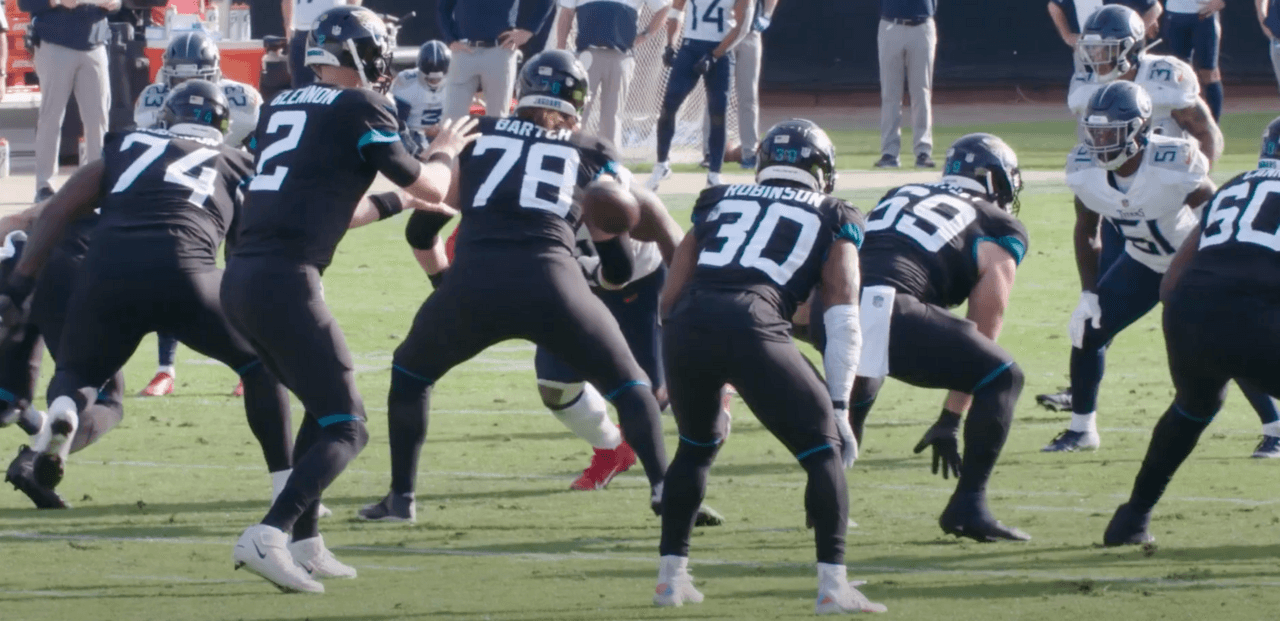
The Jacksonville running back room reset this offseason, and the biggest winner is Bhayshul Tuten. With Travis Etienne gone to New Orleans, the second-year back out of Virginia Tech is the clear front-runner to handle the early-down and pass-down work in Liam Coen's offense, and fantasy drafters have noticed. Tuten's ADP has been one of the fastest risers of the summer, and the case for chasing him is straightforward: real athletic traits, a vacated workload, and a coaching staff that wants to run the football.
The setup in Jacksonville
Etienne's departure left a lead role on the table, and Tuten is the most talented option to fill it. A fourth-round pick in the 2025 NFL Draft, Tuten spent his rookie season as the change-of-pace back behind Etienne, working in a limited role while the staff leaned on the veteran. That arrangement no longer exists. The job is open, and Tuten enters camp atop the depth chart with the inside track on first-team reps.
The context matters as much as the opportunity. Coen's offenses are built to stay ahead of the chains and to feed a primary back in both the run game and the screen and check-down game. A lead back in that structure does not just compile carries; he sees targets, and target volume is what separates a flex piece from a weekly starter in PPR formats. Tuten profiles as a three-down option, which is exactly the type of back who can outrun his draft cost.
What Tuten showed as a rookie
The rookie tape was encouraging even in a small sample. Tuten flashed the burst and contact balance that made him a draft riser out of Virginia Tech, ranking near the top of the league in rushing success rate among qualifying backs and grading well in missed-tackle rate and yards after contact. Those are sticky, translatable traits: backs who force missed tackles and create yardage after contact tend to keep doing it when the workload grows.
His counting stats were modest because his usage was modest. As a backup he handled fewer than 100 touches and turned them into a handful of touchdowns and a few hundred scrimmage yards. The point is not the raw production; it is the efficiency on limited volume. When a back is that productive on a per-touch basis as a rookie and then has the depth chart clear in front of him, the projection curve bends upward in a hurry.
The committee catch
The one thing standing between Tuten and a true bell-cow workload is Chris Rodriguez. Jacksonville added Rodriguez to the room, and he profiles as a downhill, between-the-tackles complement who could carve out early-down and short-yardage work. That is the catch on the breakout thesis: this is more likely a lead-back-plus-complement split than a 20-touch monopoly, and goal-line equity is the swing factor for fantasy scoring.
That does not sink the case, but it does cap the ceiling unless Tuten seizes the job outright in camp. Training-camp beat reports will be the tell. If Tuten is taking the bulk of first-team reps and showing he can pass-protect well enough to stay on the field on third down, the committee tilts heavily his way. If Rodriguez is vulturing inside the five, Tuten's touchdown projection takes a hit even if he leads the team in yardage.
The Verdexed model take
Verdexed's projection model treats Tuten as a high-variance RB2 with a path to weekly RB1 weeks if the workload consolidates. The model likes the situation: a run-leaning scheme, a vacated lead role, and a back whose efficiency metrics support a larger sample. The risk it prices in is the touchdown distribution, which is why Tuten grades as a better bet in full-PPR than in touchdown-heavy standard formats, where Rodriguez's potential short-yardage role bleeds value.
The edge versus the market is timing. Tuten's ADP is rising, but the model still views the cost as reasonable relative to the range of outcomes. Drafters who wait two more weeks may be paying a round earlier than they would today. The actionable read is to treat current ADP as a buying window, not a peak.
The betting angle
The Jaguars' backfield resolution carries a betting dimension too. A run-leaning offense that consolidates touches into one back tends to support rushing-prop markets once the workload is clear, and Tuten's anytime-touchdown and rushing-yardage lines will be priced off camp reporting. If he wins the job outright, his rushing-yards number should open conservatively before the market catches up to a player without a long track record of volume. That lag is where the early-season value lives for bettors willing to trust the projection ahead of the box scores.
What to do in your league
For redraft, Tuten is a target at the Round 4 to Round 5 turn in PPR, where the combination of vacated volume and athletic upside outweighs the committee risk. He is the kind of pick that can return a discount if he wins the job cleanly, and even the floor outcome of a lead role in a committee plays as a usable flex.
For dynasty, the value is higher still. Tuten is a cheap second-year asset attached to opportunity, and the acquisition cost remains modest compared with backs in more crowded rooms. Managers in win-now builds should be calling Tuten owners now, before a strong camp report moves the price.
The one number to watch between now and Week 1 is pass-down usage. If Tuten is the back on the field on third-and-6, his floor is a weekly starter regardless of how the goal-line work shakes out. If Rodriguez is the passing-down option, temper the ceiling and treat Tuten as a touchdown-dependent RB2. Either way, the arrow is pointing up in Jacksonville, and the time to act is before camp confirms it.